Welcome to The Classical Astrology website!
This website is dedicated to the Western traditional astrological practice. This means we practice the celestial art by honoring the timeless, therefore proven principles of the traditional wisdom against the background of our modern times. The traditional practice draws a clear line, distancing itself from the modern application of astrology, prioritizing accurate and tangible information over vague and elusive answers.
In Classical Astrology, there is a commitment to navigate the cosmos keeping in heart and practice the fundamental truths of the astrological wisdom as it was delivered to us through the centuries, seeking clarity and precision in understanding of the universe and how it is reflected in our daily lives.

The Content in Classical Astrology
The aim of Classical Astrology is the revival of the traditional astrological principles and their application to various aspects of modern life. Here, the reader can find different topics concerning the everyday practice of the Traditional Astrology using the traditional techniques of Horary, Natal, and Electional Astrology.
The Classical Astrology continually evolves, integrating fresh ideas and themes, always in respect to the traditional thought. New articles are therefore in the works.
Consultations
If you’re seeking clear, precise, and concrete answers to your personal matters, Classical Astrology can provide you just that with the use of Traditional Horary Astrology. Through Traditional Horary Astrology, you can gain insight into all personal matters concerning the past, present and future. Although it is known for its predictive value, horary can offer a deeper understanding of challenging situations, illuminating their current state and future development.
For more information Traditional Horary Astrology advice, please click here.
The practice of the astrological tradition in the 21st century.

The Latest Horary Question
| Below, you will find a collection of recent articles focused on the practice of Traditional Horary and Natal Astrology, as well as pieces exploring the theory behind the astrological craft. These articles are continuously updated and will soon expand to include topics on Traditional Medical Astrology, Electional Astrology, and Mundane Astrology:
The Outer Planets
In traditional astrology, the outer planets—Uranus, Neptune, and Pluto—hold a special but non-essential role. Unlike in modern astrology, these planets are not treated as true planets within the framework of traditional practice; they don’t rule…
The Malefic Houses
The Ascendant’s Vital Force The instant of an individual’s first breath into life, the very first breath that marks their entry into existence is curved up on the eastern horizon of the horoscope, the Ascendant.…
The Myth of Medusa
After Uranus castration by Saturn that allowed the Titans to rule the Cosmos, Gaia (the Earth) laid with Pontus, the pre-Olympian god of open sea, to bring into life many of the divine creatures of…
The Lord Of Geniture
The Lord of Geniture Imagine suddenly waking up at night to find yourself in a small boat, floating in the middle of a stormy ocean. Around you, darkness stretches endlessly, and your only guidance through…
TRANSITS IN SYMBOLISM
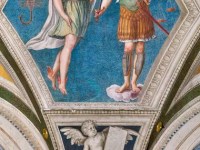
Mars in Virgo, 17/6/2025 – 6/8/2025
On June 17, Mars will leave the sign of Leo and enter the sign of Virgo. For most of its time in Virgo, Mars will be peregrine, except in the final degrees where it will have some minor essential dignity, being in its own Term. Therefore, for most of its time in Virgo, Mars will…
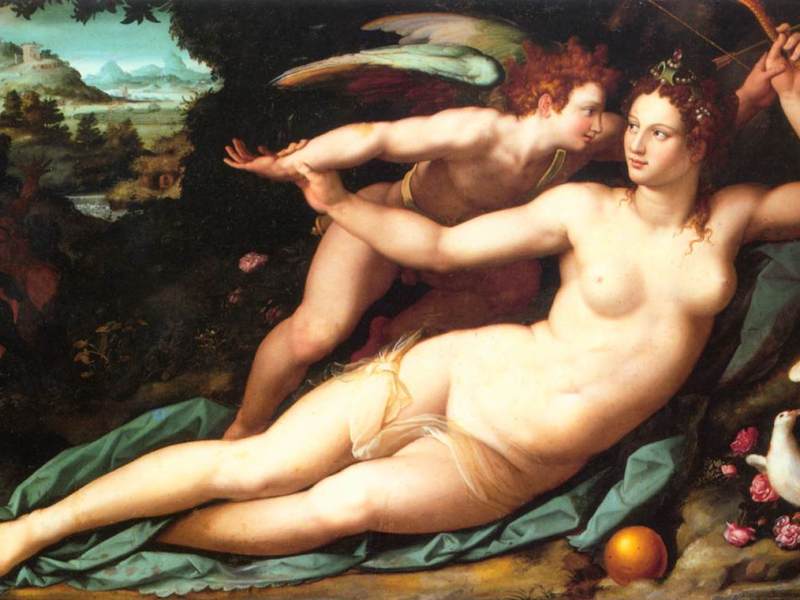
Venus in Taurus, 6/6/2025 – 4/7/2025
On the 4th of July, the planet of union and pleasure, Venus, leaves the airy sign of Gemini and enters the earthy sign of Taurus, its zodiacal home. In Taurus, Venus is in its domicile and, during the day, in its triplicity. Venus becomes essential dignified, allowing it to fully express its Venusian qualities when…
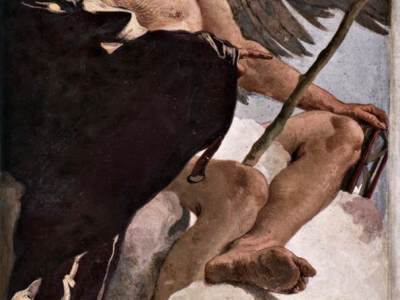
Saturn in Aries, 24/5/2025 – 13/4/2028
For about two years, Saturn, the planet of boundaries and limitations, has been traveling through Pisces, where it will remain until May 24, 2025, before moving into a challenging position for it—the sign of Aries, its fall. Saturn will stay in Aries until early September when, due to its retrograde motion, it will re-enter Pisces.…
The truth is that traditional astrology places little to no emphasis on the influence of planetary transits on our sub-lunar world. In contrast, modern astrologers often rely heavily on transits for their predictive techniques. Historically, William Lilly’s Christian Astrology—a text of over 800 pages—dedicates barely two pages to transits, focusing instead on techniques like secondary progressions and returns.
This perspective makes sense if we consider that if transits truly dictated events, every time the Sun crossed the cusp of the 8th house, we would meet our demise, or humanity would face collective heartbreak every time Venus turned retrograde. However, an unbiased observation of transits shows that these correlations simply do not hold. When similar events occur repeatedly in our lives, the corresponding transits differ, showing no consistent connection with our natal chart. Instead, we tend to project blame onto the planets, using the sky as a scapegoat for our negative experiences. These events feel more significant than positive ones, yet we rarely take note of the astrological conditions during favorable times.
Personally, the only value I find in transits lies in the symbolism that emerges as planets move from one sign to another. This symbolism can be particularly useful in certain applications of Electional Astrology to favor certain activities.
 The Classical Astrology